











The order is released. The cutter is ready. Then someone realizes the active reel doesn’t have enough footage.
There might be another reel in reserve. There might be a remnant somewhere in the building that’s perfect for the job. But if the warehouse doesn’t know exactly what footage is available and where, someone must find it.
That’s when a seemingly small inventory problem becomes a cut-floor problem.
It’s also why reel tracking, cut planning, and replenishment can’t really be designed independently. Cut planning depends on accurate reel data. Replenishment depends on knowing what’s coming next, and reel tracking needs to reflect what actually happened at the cut.
A WMS can bring those pieces together, but only when it’s designed around how wire moves through the operation.
What a WMS Needs to Know About Every Reel
Wire management in a WMS starts with treating each reel as a uniquely identified inventory record. Its remaining footage, lot, status, and location should update as the reel is moved and consumed.
That gives the WMS something much more useful than “We have this item in stock.” It can answer, “Do we have a reel that can actually make this cut, and where is it?”
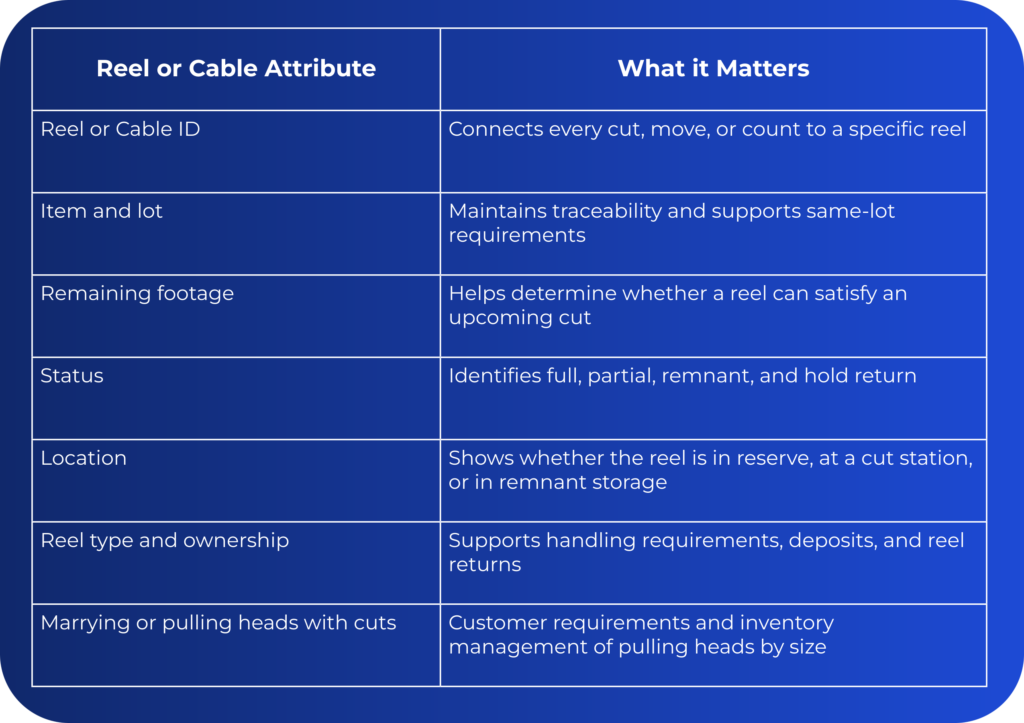
Units of measure and footage conversions also need to be maintained correctly in the item master. Otherwise, even the smartest allocation rule is deciding with questionable data.
This is also where WMS and ERP integration becomes important. One of the first design decisions is determining which system owns attributes such as orders, inventory reservations, reel information, and footage. Open Sky Group discusses that broader ownership question in WMS Systems Integration: Keys to Success, Part 1.
Reel Tracking: Keeping Footage and Lot Accurate Through Every Cut
Once every reel has an identity, reel tracking becomes a series of inventory transactions tied back to that identity.
At receiving, the reel can be captured with its item, lot, and starting footage.
When someone makes a cut, the transaction is confirmed against that reel. If 250 feet were used, for example, the available footage on that reel should be reduced accordingly.
But that’s not where tracking stops.
If the remaining wire is still usable, it may become a partial reel or remnant with its own status and storage location. When that reel moves from reserve to a cut station, then into remnant storage, the WMS maintains that movement history.
And when material leaves the reel, the connection still matters.
The cut piece should retain the reel and lot information it came from through staging and shipping. Now, basic lot tracking is transformed into meaningful lot traceability. Instead of knowing only which lot entered the warehouse, the business can trace material from the original reel through the finished cut and ultimately to the customer.
Cycle counting changes, too. Counting that three reels are physically present doesn’t tell you how much usable wire you really have. Partial reels and remnants need to be verified by footage.
What to track: footage variance during counting and the percentage of cuts confirmed against a reel ID.
Cut Planning: Matching Order to the Right Reel
Knowing what’s on each reel solves one part of the problem.
The next question is: Which reel should be used?
Without defined rules, that decision often lands with whoever happens to be planning or cutting the order. One shift may grab a new reel. Another may hunt for a remnant. Both can technically fulfill the order, but they can create very different inventory outcomes.
A WMS can make that decision more intentional through soft allocation, identifying which reel or remnant should supply a cut before work reaches the floor.
The rules will depend on the operation, but a wire or cable distributor might decide to:
- Use a remnant first when it can satisfy the required length
- Select the reel that avoids leaving footage below the minimum usable length
- Keep related cuts on the same lot when the customer’s requirements call for it
- Favor a suitable reel already at the cut station when doing so avoids an unnecessary reel change
Those are not universal rules, and they shouldn’t be. They are business decisions that should be made during process design.
The same concept becomes particularly important for parallel and stacked cuts. Related order lines need to remain coordinated so the cut instructions, reel requirements, lot requirements, and eventual staging don’t drift apart as work moves through the warehouse.
The goal isn’t simply for the WMS to pick a reel. It’s to consistently choose an appropriate reel based on the way your operation wants to use inventory.
What to track: the percentage of cuts fulfilled from remnants and reel changes per 100 cuts.
Replenishment: Getting the Right Reel to the Cut Station Before It’s Needed
Here’s where normal warehouse replenishment logic can run into trouble with wire.
A reel can be in stock and still be too short for the next cut.
If a system only looks at units or reels on hand, the cut location may appear stocked. Operationally, however, it doesn’t have what it needs.
Suppose the next cut requires 800 feet and the reel at the station only has 500 feet remaining. The WMS needs to recognize the footage requirement, not simply the presence of inventory.
Depending on the operation, there are a few ways to respond:
- Replace the active reel with an appropriate reel from reserve
- Maintain a second reel or pick face
- Move inventory based on upcoming cut demand and the usable footage available at the station
That’s the difference between simply replenishing inventory and replenishing for the work that’s about to happen.
Demand Replenishment vs. Min/Max Replenishment
For wire and cable, both approaches can have a place.
Demand replenishment looks at upcoming requirements and brings forward the inventory needed to satisfy them. If tomorrow or the next wave’s cuts require more footage than the current reels can provide, replenishment can act before cutting starts.
Max/min replenishment uses established inventory thresholds. When available inventory drops below a defined minimum, the system replenishes toward the maximum.
The right answer doesn’t need to be one or the other. The appropriate strategy depends on order patterns, cut-floor layout, reel storage, handling constraints, and when the operation has enough information to anticipate upcoming demand.
The important thing is timing. Replenishment should put the next usable reel where it needs to be before the cutter is waiting for it.
Where reels significantly impact travel and material movement. Warehouse slotting should be part of the conversation rather than an afterthought.
What to track: cuts delayed while waiting for a reel and emergency reel moves per shift.
How Reel Tracking, Cut Planning, and Replenishment Work Together
This is where the pieces start reinforcing one another.
Accurate footage feeds cut planning. Cut planning gives replenishment visibility into what’s needed next. Replenishment gets the appropriate reel into position. The completed cut then updates the reel’s remaining footage and creates the information needed for the next planning decision.
Each order informs cut planning, which determines what must be replenished before cutting begins. Once the cut is confirmed, the WMS updates the reel’s remaining footage and remnant status, keeping inventory accurate for whatever comes next.
Staging and shipping become the exit from the loop once the cut is complete.
When the information stays connected, cutters spend less time looking for reels or dealing with surprise shortages, and cut-floor execution becomes more predictable.
Configure, Extend, or Customize? Don’t Start with Customization
At this point, the IT reaction can understandably be: This sounds specialized. How much custom code is this going to take?
That’s the right concern, but customization shouldn’t be the starting assumption.
Open Sky Group generally looks at WMS requirements through three lenses:
Configuration uses settings, rules, and capabilities already available within the standard product.
Supported extensions add necessary functionality through vendor-supported extension points without changing the core product code.
True customization changes the base product itself and can introduce additional work when the platform is tested, maintained, or upgraded.
Complex wire operations can absolutely uncover gaps. But a specialized process doesn’t automatically require a customized WMS.
The first step is understanding the requirement well enough to identify the gap.
For example, saying “we need reel tracking” isn’t yet a system requirement. How do you identify a reel? When does footage change? What makes a remnant usable? Which cuts must share a lot? Who determines reel ownership? What happens when the recorded footage doesn’t match the physical reel?
Once those questions are answered, the team can decide what can be configured, what makes sense as a supported extension, and what truly requires something more.
That’s the principle behind Open Sky Group’s no- to low-modifications approach: don’t introduce unnecessary complexity when the requirement can be addressed in a more supportable way.
It’s particularly important when you’re thinking beyond go-live. Today’s solution still must survive tomorrow’s upgrade. Upgrading WMS or Is It Time to Replace? looks more closely at that lifecycle decision.
Wire requirements are easier to solve during design than after go-live. Open Sky Group works through those requirements first, separating what can be configured, what should be extended, and what truly needs customization so the process remains practical to support and upgrade.
See How Wire Replenishment Can Be Designed for Your Operation
Before designing technology around wire and cable, it helps to understand exactly where the current process breaks down.
A Wire Operations Assessment can look at reel handling, cut planning, replenishment, and the handoffs between them. From there, Open Sky Group can review your wire WMS requirements and determine which belong in configuration, supported extensions, or true customization.
See how wire and cable replenishment can be designed for your operation.
Talk to an Open Sky Group advisor about a Wire Operations Assessment.
For IT and transformation teams, the next step can be even more focused: Review Your Wire WMS Requirements.