










Go-live is one of the most important milestones in any warehouse transformation.
Your organization has invested in SAP Extended Warehouse Management (EWM), users are operating on a new environment, and the warehouse is running on a platform designed to provide greater control, visibility, and scalability.
But go-live is not the finish line.
Many organizations discover that while SAP EWM is working as intended, some of the operational improvements they expected have not been fully realized. Throughput may still have room to improve. Manual workarounds may exist in certain areas. Automation may not be performing as smoothly as expected. Visibility may be better than before but still not where leadership wants it to be.
None of this necessarily means something is wrong with SAP EWM.
More often, it reveals opportunities to optimize processes, refine configurations, improve integrations, strengthen user adoption, and align operations more closely with the capabilities already available in SAP EWM.
In other words, they diagnose before they prescribe.
Signs Your SAP EWM Environment Has Opportunities for Improvement After Go-Live
SAP EWM provides a powerful foundation for warehouse execution, but operational results are influenced by much more than software alone.
Processes, data, integrations, automation, reporting, and user behavior all play an important role in determining how much value an organization ultimately receives from its SAP investment.
Here are some of the most common indicators that additional optimization opportunities exist.
Throughput Has Improved, But Not as Much as Expected
Perhaps orders are moving more efficiently than they were before implementation, but not enough to achieve the business case.
Peak periods still create congestion. Labor productivity gains have plateaued. Certain processes continue to take longer than expected.
In many cases, SAP EWM is functioning properly. The opportunity is not the software itself; many times, the opportunity lies in the fine-tuning.
Some Work is Still Happening Outside the System
Walk through almost any warehouse a few months after go-live, and you may still find spreadsheets, whiteboards, paper notes, or supervisor-developed tracking tools.
Do not automatically view this as a failure. Instead, these workarounds often reveal where users compensate for operational gaps, recurring exceptions, or process challenges.
The question is not whether workarounds exist; the question is why they exist and what they are trying to solve.
Visibility is Better, But Decisions Still Take Too Long
One of SAP EWM’s greatest strengths is the visibility it can provide into warehouse activity.
Yet some organizations still struggle to answer critical questions quickly:
- Where is work backing up?
- Which exceptions are occurring most frequently?
- What is limiting throughput today?
- Which process area needs attention first?
If teams spend significant time investigating problems before they can solve them, additional visibility improvements may be available.
Automation is Not Yet Delivering Its Full Potential
Automated warehouses rely on a complex network of technologies working together.
SAP EWM, warehouse execution systems, warehouse control systems, conveyors, AS/RS systems, sorters, and robotics all need to communicate effectively.
Industry experts note that performance challenges often emerge not within a single system, but at the interfaces between them. Delays, queue buildups, exception handling, and communication bottlenecks can all affect performance.
When automation performance falls short of expectations, there is often a significant opportunity to improve coordination across the technology ecosystem.
User Adoption Is Still Evolving
Every warehouse develops new habits after go-live.
Users learn faster ways to complete work. Supervisors develop preferences. Operational teams refine workflows based on real-world experience.
Sometimes these adaptations highlight opportunities to simplify processes, improve training, reduce unnecessary steps, or better align system workflows with how work actually happens on the floor.
Common SAP EWM Symptoms and What They May Be Telling You
After SAP EWM goes live, operational challenges often reveal opportunities for optimization. Low throughput is frequently tied to workflow bottlenecks, configuration choices, process gaps, or labor constraints. Start by evaluating wave and release strategies, slotting travel paths, and resource allocation, then measure lines per hour, travel time, and task wait time to pinpoint where productivity is being lost.
Manual work is another sign that processes need refinement. Integration gaps, poorly designed workflows, and recurring exceptions often force users to rely on workarounds outside the system. Focus on where work leaves SAP EWM and why, then quantify the impact through manual postings, adjustments, and exceptions.
Limited visibility can make it difficult to identify issues before they affect performance. These challenges are often rooted in reporting structures, data quality, integrations, or monitoring processes. Review how KPIs are defined and how quickly operational events are converted into actionable insights.
Automation friction typically occurs at the handoff points between SAP EWM, WES, WCS, and automation systems. Identifying where tasks stall between applications can uncover opportunities to improve flow, reduce exceptions, and maximize the value of automation investments. Handoff latency and exception rates are often the clearest indicators of these issues.
The objective is not to immediately fix what appears broken; the objective is to identify where the operation is losing performance and determine the root cause before introducing changes.
The Path to SAP EWM Stabilization and Optimization
Organizations often jump directly to new projects, system enhancements, additional technology investments, or reconfiguration efforts.
A better approach is to first understand what will deliver the greatest operational impact.
1. Find the Root Cause
Start by bringing together multiple sources of information:
- System data
- Warehouse KPIs
- User feedback
- Process observation
- Exception analysis
- Automation performance metrics
The goal is to determine whether the issue originates from process design, configuration, integrations, data quality, automation, or adoption.
2. Prioritize the Highest-Impact Improvements
Not every opportunity deserves immediate attention. Focus first on the changes most likely to improve:
- Throughput
- Productivity
- Inventory accuracy
- Visibility
- User adoption
- Automation performance
In many environments, a relatively small number of changes can produce meaningful gains.
3. Validate Performance on the Floor
The final step is ensuring improvements translate into measurable operational outcomes. Success should not be measured by completed tickets or configuration changes. Measure it by what happens in the warehouse.
Quick Diagnostic Questions
Before launching a major optimization effort, ask:
Which warehouse process is struggling most?
Which KPIs changed after go-live?
Are the same exceptions or workarounds occurring repeatedly?
How long has the operation been live?
The answers often narrow the investigation significantly and help teams focus their improvement efforts where they can create the greatest value.
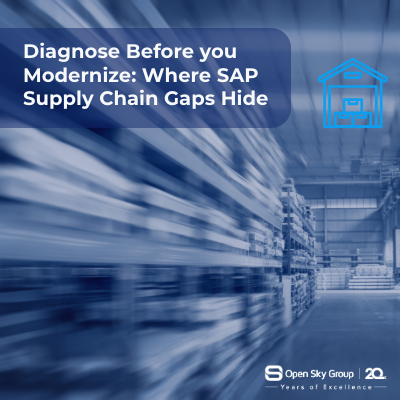
Diagnose the Operation Before You Reimplement SAP EWM
The most important takeaway from this article is clear: a struggling warehouse does not automatically mean SAP EWM is failing.
More often, the challenge lies somewhere between system configuration, process design, data quality, integrations, automation, and user adoption.
The organizations that achieve the greatest value from SAP EWM resist the urge to prescribe solutions too early. They diagnose first, identify the real constraints, and then build a roadmap based on evidence rather than assumptions.
Once the root causes are clear, the path forward becomes much easier to define.
Some problems require process improvements. Others need configuration changes, integration enhancements, automation tuning, or focused training. And in some cases, a broader modernization initiative may be the right answer.
The difference is knowing which one before committing time and budget. The key to knowing is picking the right partner.
That is where Open Sky Group helps. By combining operational analysis, SAP EWM expertise, and hands-on warehouse experience, we help organizations uncover root causes, prioritize improvements, and create a roadmap that drives measurable results. The goal is not simply to make SAP EWM work; it is to help your warehouse perform at its full potential.