










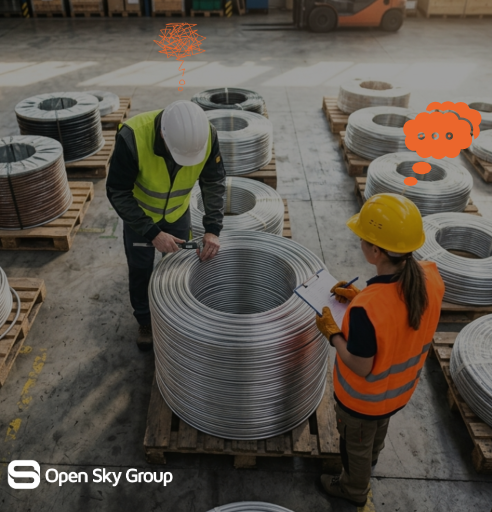
Wire isn’t just another SKU.
That sounds obvious when you’re standing on the cut floor. But many warehouse processes aren’t designed that way. They’re built around inventory that arrives as an each, case, or pallet and leaves the building in the same, or similar, form.
Wire doesn’t cooperate with that model. Every cut changes inventory. The right reel for one order may be the wrong reel for the next. A cut can create a remnant that needs to become usable inventory. And several order lines may need to stay connected through cutting, staging, and shipping.
When the warehouse management process hasn’t been designed for those realities, the work doesn’t disappear. It moves into spreadsheets, paper cut tickets, side conversations, the ERP, or the heads of experienced employees.
That’s where the real problem starts.
We recommend looking at the assumptions behind traditional warehouse management, where they break down for wire and cable distributors, what those workarounds mean as an operation grows, and what a more wire-ready process looks like.
What Traditional Warehouse Management Assumes
Most traditional warehouse processes assume an item has a fixed unit of measure, exists in a location as a countable quantity, and leaves the building in the same basic form in which it arrived.
For much of a distributor’s inventory, that’s perfectly reasonable.
An item might be received as a case, stored as a case, picked as an each using a fixed conversion, and shipped. Inventory movements can be expressed as relatively simple additions and subtractions.
That model tends to rely on several assumptions:
- Units of measure are fixed, or conversions between each, case, and pallet are predictable
- Picking subtracts a known quantity from a location
- One order line can be translated into a defined pick task
- Replenishment is triggered when inventory drops below a defined threshold
- Lot or serial information follows the inventory received into the warehouse
These assumptions are useful, but they aren’t universal. That’s one reason understanding your actual operational requirements matters before choosing or configuring WMS features. As we’ve discussed in Myths of Buying a WMS, technology alone doesn’t define the right warehouse process.
Wire exposes that difference quickly.
Breaking Assumptions: Wire and Cable
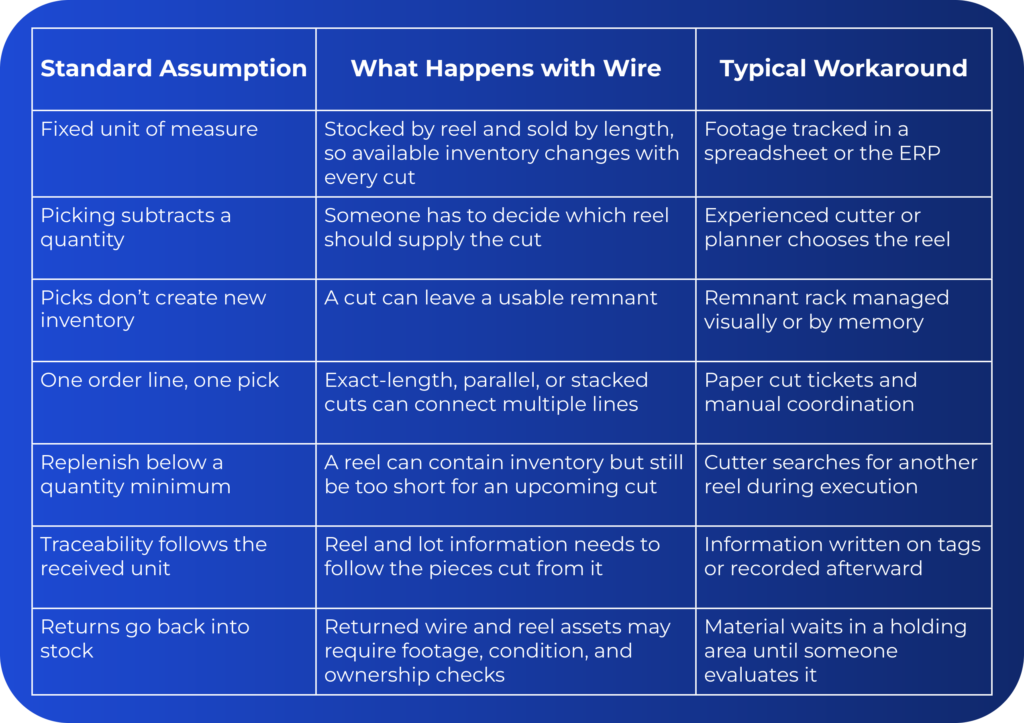
These aren’t unusual; they’re everyday decisions that make inventory management different when wire enters the picture. Additionally, eaches can be combined across locations, while wire must come from one continuous length in a single location.
The Unit Changes With Every Cut
With most warehouse inventory, picking changes the quantity on hand, but it doesn’t change the product itself. Wire is different.
Every cut changes what remains on the reel. A reel might arrive with thousands of feet, but as orders are filled, its available footage continuously changes. What’s left may become a useful remnant for another order, or it may not be enough to satisfy the next cut.
This makes wire difficult to manage using the same fixed unit-of-measure logic that works well for eaches, cases, and pallets. The system needs to know more than how much inventory exists. It also needs to maintain an accurate picture of where that footage exists and whether it can fulfill upcoming demand.
And once you know what inventory is available, there’s another question a traditional picking process doesn’t always answer: which reel should you actually use?
Reel Selection Is a Decision; Not a Lookup
For many products, allocation is typically straightforward. The process usually follows: find the inventory, reserve the required quantity, and create the pick.
Wire and Cable add another layer of decision-making.
Multiple reels may contain the same item, but that doesn’t make them equally good choices. Available footage, existing remnants, future cuts, location, the required cut length, and what’s likely to remain afterward can all influence which reel is recommended.
When those rules aren’t built into the process, an experienced cutter or planner often makes the decision.
And that approach can work surprisingly well, until the business needs to train someone new, increase volume, add a shift, or replicate the process at another location. Suddenly, knowledge that kept work moving becomes difficult to scale.
Reel selection also affects more than an individual cut. Some orders require several wire pieces to be executed together.
Some Cuts Can’t Be Treated as Separate Picks
Exact-length, parallel, and stacked cuts can create relationships between order lines that need to stay intact as the order moves through the warehouse.
That’s where a standard “one order line, one pick” mindset can start to break down.
The cut floor needs to know which pieces belong together, how they should be cut, and where they need to go next. Those relationships also need to follow the order through staging and shipping.
If the warehouse process doesn’t maintain that connection, people must recreate it with paper cut tickets, notes, spreadsheets, or manual coordination.
The result isn’t necessarily a visible system failure. Orders may still ship, and inventory may still move; but more of the process happens around the WMS rather than through it.
That leads to a more impactful question, not simply asking whether your WMS can “handle” wire.
How Much of Your Wire Process Lives Outside the WMS?
Look at how work moves through your operation:
- Does cut planning happen in a spreadsheet or on paper before work reaches the floor?
- Do cutters decide which reel to use largely based on what’s nearby or what they already know?
- If footage in the system doesn’t match the reel, do employees trust the physical reel instead?
- Are remnants found through memory rather than a defined status and location?
- Are parallel or stacked cuts coordinated manually?
- Do new cutters or planners depend heavily on experienced employees before they can confidently make decisions on their own?
The more familiar these situations sound, the more likely it is that critical wire and cable knowledge lives with your people, rather than within a repeatable process.