











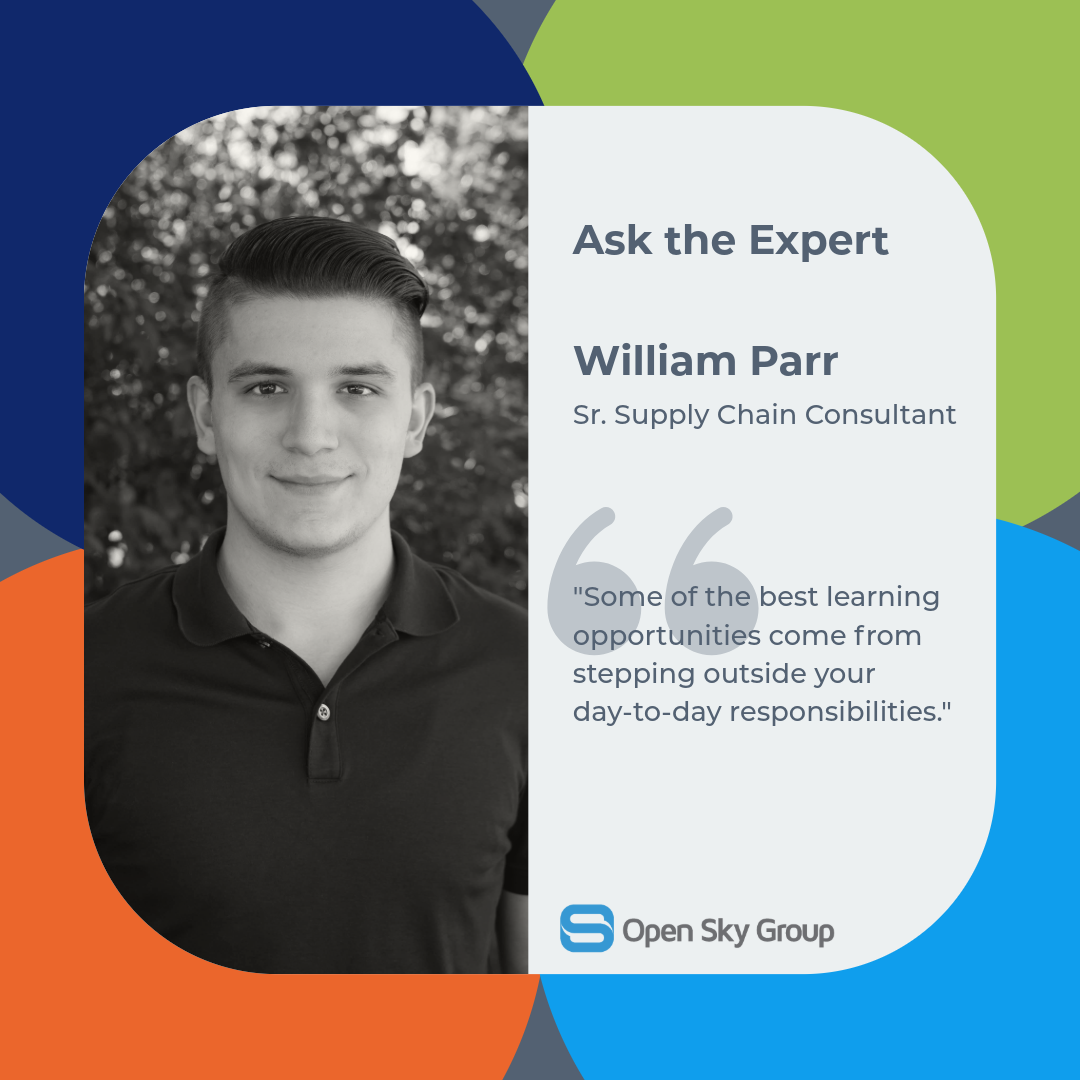
William Parr
Title: Sr. Supply Chain Consultant
Years with OSG: 8
Years in Supply Chain: 8
Ask the Expert
What does your day-to-day look like?
No two days are the same, which is one of the things I enjoy most about consulting. Depending on the phase of the project, I might be facilitating discovery and design workshops, translating business requirements into system configurations, building integrations, or developing custom enhancements, labels, and reports to support unique operational needs. As projects move into testing and deployment, I help guide customers through SIT, UAT, and user training. During go-live, my focus shifts to floor support, issue triage, stakeholder communication, and helping operations teams successfully transition into their new processes. What I enjoy most is being involved throughout the entire project lifecycle, from the initial concept and solution design to seeing customers realize the benefits in their day-to-day operations.
How did you get started in supply chain?
I got started in supply chain by pursuing a Bachelor of Business Administration with a major in Logistics and Intermodal Transportation and a minor in Information Technology. What initially attracted me to supply chain was the combination of operations, technology, and problem-solving. After graduating, I joined OSG to support its growing Transportation Management System (TMS) practice. In that role, I helped validate system performance, stress test transportation processes, verify master data integrity, and develop user testing scenarios. It was an excellent introduction to the technology that powers supply chain operations and gave me firsthand experience solving real-world logistics challenges.
How does supply chain impact a company’s broader strategy?
Supply chain plays a critical role in a company’s broader strategy because it directly impacts customer satisfaction, operational efficiency, and profitability. Even organizations that don’t view themselves as logistics-focused rely on effective supply chain practices ot meet customer expectations, control costs, and ensure products, materials, and services are available when needed. In today’s environment, supply chain is no longer just an operational function. It’s a strategic driver that supports growth, resilience, and long-term business success.
What do you view as the biggest challenge in the current supply chain environment and how can it be solved?
One of the biggest challenges I see is resistance to change during digital transformations. Too often, organizations focus on recreating existing processes ina. new system rather than using the opportunity to improve them. For example, I still encounter companies that rely on manual inventory updates between systems when automation is available, introducing unnecessary risk and inefficiency. The most successful organizations embrace change, adopt best practices, and view technology as a catalyst for innovation rather than simply a replacement for the system they’re leaving behind.
What philosophy do you follow while working with customers?
My philosophy is to listen not only to a customer’s current needs but also to their long-term roadmap. The goal is to build solutions that solve today’s challenges while supporting tomorrow’s growth. At the same time, I strive to advocate for best practices and help customers identify opportunities to improve processes, not just implement technology.
Please share your favorite success story.
I’d have to say developing a dynamic solution for a customer whose suppliers provided products in inconsistent configurations with little to no supplier compliance. Products could arrive with different case quantities, packing structures, and pallet configurations, creating significant operational challenges. Working within the customer’s business rules, I designed a solution that adapted to those variations and supported the entire process from receiving through fulfillment. It was a rewarding Proust because it transformed a highly unpredictable environment into one that could be managed efficiently and consistently.
What advice would you give to someone looking to enter the supply chain industry?
My advice is to volunteer for new initiatives whenever possible. Being part of change and innovation helps you expand your skill set, gain exposure to different areas of the business, and accelerate your professional growth. Some of the best learning opportunities come from stepping outside your day-to-day responsibilities.
What is a fun fact about yourself that your clients may not know?
I love live music and going to concerts, with metalcore being my favorite genre. Most people don’t expect it, but I’m no stranger to most pits, circle pits, walls of death, and even the occasional crowd surfing. It’s a great way to unwinder, enjoy the energy of the crowd, and experience something completely different from my day-to-day work.