








Most supply chain leaders are past the “should we use AI?” debate. The pilots have happened. The vendor demos are done. What’s left is the harder question: how do you turn AI investment into measurable supply chain outcomes without fragmenting your tech stack, burning out your planners, or buying a model that nobody trusts six months later?
That question is what an AI strategy actually answers. As Pedro Quiterio, an Open Sky Group senior supply chain consultant, has framed it, generative AI is the next logical progression of predictive analytics and machine learning combined, and the right way to think about it is staff augmentation rather than replacement. Strategy is what keeps that augmentation focused on outcomes you can measure—throughput, cost-to-serve, on-time in-full, inventory accuracy, instead of capabilities you can demo.
This guide walks through ten steps that supply chain VPs and Directors can use to build an AI strategy that survives contact with their warehouse floor. It covers readiness auditing, use case prioritization, data foundation, build vs. buy decisions, change management, KPIs, pilot scaling, and governance. You can use it as a checklist for an internal working session or as a reference for your next planning cycle.
Why an AI Strategy Is the Real Job (Not “Should We Use AI”)
Most articles on AI in the supply chain spend their word count defining what AI does. That ground is well covered. Demand forecasting, anomaly detection, predictive maintenance, conversational interfaces, agentic workflows—these capabilities are no longer novel. The unsolved problem for operating leaders is how to assemble those capabilities into a coherent program that ties to business outcomes.
Three reasons make strategy the real job. First, most failed AI initiatives in supply chain do not fail at the model layer. They fail at the strategy layer—wrong use case, wrong sequencing, weak data foundation, no change plan. Second, Tier-1 WMS, TMS, and LMS systems already embed AI features, which means the question for most operations is not whether to adopt AI but how to choose, layer, and govern AI capabilities across systems already in place. Third, without a strategy, AI investment fragments into tool sprawl. Every department buys its own assistant or analytics layer, integration costs balloon, and the operating data model fractures.
A useful supply chain AI strategy answers three things: which business outcomes AI is supposed to move? Which capabilities are required to move them? And, how will those capabilities be delivered, governed, and measured over time? The ten steps below walk through that build.
Step 1: Run an AI Readiness Audit Across Operations
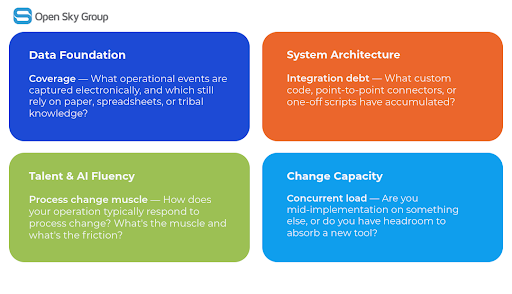
Before any model gets selected or any pilot scoped, you need a clear picture of where your operation is starting from. The readiness audit covers four dimensions: data, systems, talent, and change capacity. It’s the same kind of technology health check that Open Sky Group’s consultants run before any major implementation, and it gives you a defensible answer when finance asks why a particular use case is or isn’t ready.
Audit your data foundation
Data is the single biggest determinant of whether an AI use case will work. Walk through your current state and document the answers honestly.
- Coverage: what operational events are captured electronically, and which still rely on paper, spreadsheets, or undocumented tribal knowledge?
- Quality: how clean is the data—master item, customer, location, vendor, carrier? When did you last reconcile?
- Granularity: do you have SKU-level, location-level, hour-level data, or only daily aggregates rolled up to a category?
- Latency: how fresh is the data when it reaches the people making decisions—real-time, end-of-shift, end-of-week?
- Lineage: can you trace any number on a dashboard back to the source system that produced it?
If three of those five answers are weak, your AI strategy needs to start with a data foundation phase before any modeling happens. Modernizing your WMS toward intelligent automation often exposes the data gaps that block AI use cases later.
Audit your system architecture and integration debt
AI use cases live or die on the integration layer. A demand forecasting model that can’t read clean inventory data is a science experiment. A conversational interface that can’t query the WMS is a chatbot.
- What WMS, TMS, LMS, and ERP systems are in production, what versions, and how heavily customized are they?
- How many of your core systems expose modern APIs vs. requiring batch file exchange?
- Where is the master data—customer, item, vendor, location—stored authoritatively, and how often does it sync?
- What integration debt has accumulated from custom code, point-to-point connectors, or one-off scripts?
- Are your systems on-premise or cloud, and what does your hosting roadmap look like over the next 24 months?
Operations running heavily customized legacy WMS often discover that the no-modifications approach is the prerequisite to AI adoption, not just a nice-to-have. Custom code makes upgrades hard, and AI features ship through upgrades.
Audit your team’s AI fluency and change capacity
Technology is only half the readiness picture. The other half is whether your operation can absorb a new way of working without breaking.
- Which roles—planners, schedulers, dispatchers, billing teams, customer service—will use AI features daily, and what’s their current comfort with data tools?
- Do you have at least one person on the operating side who can act as a translator between the supply chain team and a data science or vendor team?
- What’s your change capacity right now? Are you mid-implementation on something else, or do you have bandwidth to absorb a new tool?
- How does your operation typically respond to process change—what’s the muscle, what’s the friction?
The audit doesn’t need to be exhaustive on day one. The goal is a snapshot you can revisit every quarter and a clear list of the gaps that have to be closed before each candidate use case can launch.
Step 2: Anchor the Strategy to Business Outcomes, Not AI Capabilities
The most common failure mode for supply chain AI strategies is letting capabilities drive the conversation. Someone demos an agent that schedules dock appointments, the team gets excited, and three months later you have a dock-appointment agent in pilot but no plan for how it changes operating cost, throughput, or customer experience.
Run the conversation in the other direction. Start with the business outcomes that already sit on your scorecard, then walk backward through the operational lever, the supply chain capability gap, and finally the AI use case that closes the gap. The structure looks like this: business outcome → operational lever → capability gap → AI use case.
A worked example: the business outcome is improving gross margin in a 3PL business. The operational lever is reducing revenue leakage from missed billable events. The capability gap is that billing depends on manual review of WMS transactions, so accessorial charges get missed during peak. The AI or automation use case is rules-based extraction of billable events directly from the WMS—what Enhanced Client Billing does in production at Arcadia Cold Storage and Logistics across five facilities. The use case ties to a number on the scorecard, not to a capability that sounded impressive in a demo.
Run that exercise for every candidate AI investment. If you can’t draw the line from a use case back to a business outcome someone is already measured against, the use case isn’t ready for the strategy.
Step 3: Prioritize Use Cases With an Effort-Impact Framework
Once you have a list of outcome-anchored use cases, you need to sequence them. An effort-impact 2×2 is the cleanest tool for the job. Effort accounts for data readiness, integration burden, change management, and time-to-go-live. Impact accounts for the size of the outcome on your scorecard, the durability of the gain, and the strategic optionality the capability creates.
[IMAGE: 2×2 effort-impact prioritization matrix with quick wins, foundational plays, transformational bets, and operational automation labeled in each quadrant.]
Use cases tend to cluster into four buckets. Each bucket asks a different question of your operation, and most strategies need a mix of all four.
Quick wins—predictive analytics for demand sensing, anomaly detection, and exception alerts
Quick wins live in the low-effort, high-impact corner. They typically run on top of data you already capture and produce insights that warehouse and transportation teams can act on the same day. Predictive analytics for demand sensing flags shifts in order patterns before the planner notices. Anomaly detection on inventory or shipping data catches errors before they become exceptions. Real-time exception alerts replace the end-of-week report with something a supervisor can use during the shift. Open Sky Group’s Supply Chain Insights lens is one productized example of this category, combining AI-driven analytics with cost-to-serve modeling at the SKU level.
Foundational plays—demand forecasting, inventory optimization, predictive maintenance, slotting
Foundational plays cost more to deploy but reshape how the operation runs. Demand forecasting and inventory optimization rebuild the planning function. Predictive maintenance changes how engineering schedules work. AI-assisted slotting changes the warehouse layout. These are not pilots that you run for three months and report on. They become part of the operating model, which is why the data foundation in Step 4 matters so much.
Transformational bets—agentic AI, conversational interfaces, autonomous orchestration
Transformational bets are the high-effort, high-impact corner. Conversational interfaces let warehouse managers query operational data in natural language—Open Sky Group’s Supply Chain Chat is one example, with customizable agents that handle sales support, operations, and load planning use cases. Agentic AI extends that pattern toward autonomous multi-step workflows, where an agent plans, executes, and confirms a chain of actions instead of waiting for human input at each step. Most operations should have one or two transformational bets in flight, not five.
Operational automation—Robotics & Automation, billing automation, labor management
Operational automation overlaps with AI but isn’t always AI. Robotics & Automation is the physical-world counterpart, with documented outcomes including a 70% reduction in operational expenses, 99.9% picking accuracy, and 25% to 50% throughput uplift in deployed environments. Billing automation through Enhanced Client Billing is rules-based, not ML-driven, but it lives in the same prioritization conversation because it sits on the same WMS data foundation. Treat this bucket as the “things AI plus automation can do together” lane, and sequence accordingly.
A simple heuristic for the prioritization itself:
- Pick one quick win to fund momentum and build internal AI fluency.
- Pick one foundational play to anchor the operating-model shift.
- Cap transformational bets at one or two, with explicit guardrails.
- Run operational automation continuously, in parallel, on the strongest data foundation.
Step 4: Build the Data Foundation Before You Build the Models
Data quality and integration are the single most cited reasons AI initiatives stall, and the audit in Step 1 should have already exposed where your gaps are. Step 4 is about doing something about them.
Three pieces matter. The first is a single source of truth for operational data—master item, location, customer, vendor, carrier—that the AI use cases will read from. The second is integration across the systems that produce the events your models need: WMS, TMS, LMS, ERP, MHE, ASRS, and the labor and billing layers that hang off them. The third is freshness. AI use cases that need to act inside the shift can’t run on a nightly batch.
The architectural pattern that has emerged in the supply chain space is a data aggregation layer that sits across the operating systems and exposes a unified view to the AI applications. Kaleidoscope, Open Sky Group’s proprietary platform, is one productized version of that pattern. It uses scalable, private microservices and a Data Lakehouse with proprietary connectors to WMS, TMS, LMS, ERP, and other enterprise systems, and it’s described as an agnostic, lightweight, data aggregation platform incorporating AI and machine learning. The category matters more than the specific platform—your AI use cases need that layer to exist somewhere, whether you build it, buy it, or layer it through a partner.
The integration points to plan for usually look like:
- WMS event streams (receiving, putaway, picking, shipping, cycle counts)
- TMS shipment, carrier, and rate data
- LMS engineered standards and labor productivity data
- ERP order, financial, and master data
- MHE and ASRS telemetry where automation is in the loop
- External signals—weather, port congestion, carrier capacity, supplier performance
Don’t build everything at once. Start with the integration footprint that the first quick-win use case actually needs, then expand by use case. The data foundation is a multi-quarter program, but it doesn’t have to gate every single AI investment.
Step 5: Choose the Right AI Approach for Each Use Case
Not every AI use case calls for the same kind of AI. Choosing the right approach for each one is half the strategy work, because mismatches—using a large language model where a regression would do, or trying to make an autonomous agent out of a forecasting model—are where budgets disappear.
Where machine learning earns its keep
Classical machine learning still does most of the heavy lifting in supply chain operations. Demand forecasting, inventory optimization, predictive maintenance, slotting optimization, anomaly detection, and cost-to-serve modeling all run on supervised or semi-supervised ML approaches that have been refined over decades. The supply chain has more structured data than most domains, which plays to ML’s strengths. Supply Chain Insights, for example, leverages machine learning and artificial intelligence to give operators a comprehensive view of cost-to-serve and to identify cost-saving opportunities by combining trend data with AI and business intelligence tools.
Where generative AI fits without overreach
Generative AI is best used as a layer that makes operational data accessible, not as a planning brain. Conversational queries against a unified supply chain dataset let warehouse managers, planners, and 3PL customer service teams ask questions like “what’s the inventory position at Hazleton tomorrow?” or “which orders are at risk for missed cutoff?” without writing reports. Document-heavy workflows—contracts, customs paperwork, exception write-ups—are another natural fit. Supply Chain Chat sits in this category. It runs on advanced natural language models, supports customizable agents tailored to use cases like sales support, operations, or load planning, and is positioned with explicit data-handling guardrails: your data is not used to train other datasets. That last point matters when finance and legal sign off on a deployment.
Where agentic AI is starting to make sense
Agentic AI is an emerging category. Where generative AI typically responds to a prompt, agentic AI runs a multi-step plan that can call tools, query systems, and confirm outcomes with humans only at decision gates. Early supply chain use cases are clustering around dock scheduling, exception triage, freight booking, and short-cycle replenishment. The honest read for most operations: pilot one agentic use case in 2026 to build internal fluency, set tight guardrails on what an agent is allowed to commit to, and don’t put agents on the critical path for shipments yet. The category will mature; your operating risk model needs to mature with it.
Step 6: Decide Build vs. Buy vs. Partner for Each Capability
Once you’ve matched use cases to AI approaches, you need to decide who builds each capability. There are usually four choices in supply chain.
The first option is native AI features inside the Tier-1 systems you already run. Blue Yonder, Generix Group, and Körber Supply Chain all ship AI capabilities embedded in their WMS and TMS platforms—forecasting, optimization, slotting, exception handling. If you’re already running one of these and you’re current on the version, the first build vs. buy question is whether the native feature does what you need.
The second is specialized point solutions—forecasting platforms, optimization engines, computer vision tools—that integrate with your core systems. Point solutions can deliver fast on a narrow problem, and they often outperform native features on a single use case. The cost is integration work and ongoing vendor management.
The third is consultant-built or productized overlays that sit on top of your core systems and combine data from multiple sources. Kaleidoscope is one example of this pattern; it’s productized, system-agnostic, sold as cloud SaaS, and designed to fill the visibility, billing, and analytics gaps that Tier-1 systems leave open. The advantage is that the overlay can deliver value across multiple core systems without forcing a platform replacement.
The fourth is in-house build. This makes sense when you have a real ML or data science team, a use case that’s genuinely differentiated for your operation, and a long-term commitment to maintain the model. For most supply chain organizations, in-house build should be reserved for one or two flagship use cases, not the default.
The decision criteria that matter:
- Time-to-value: how fast does the option produce a measurable outcome?
- Total cost of ownership: license, integration, internal staffing, ongoing maintenance, retraining.
- Integration burden: what does it take to connect the capability to your operating data?
- Customization risk: are you about to write base-code modifications? That’s an AI debt trap.
- Talent: do you have or can you recruit the people to maintain what you build?
- Governance posture: which option meets your data residency, model risk, and compliance requirements?
The customization point is where most strategies quietly accumulate the kind of debt that kills future AI upgrades. Configurations and extensibility through APIs are usually fine. Custom code that modifies vendor base systems makes every future upgrade a project. Open Sky Group’s templatized approach exists in part because of how often that pattern blocks downstream AI capability.
Step 7: Plan Change Management and Workforce Readiness
AI strategies that don’t have a change plan tend to deliver impressive demos and disappointing adoption numbers. Quiterio’s framing—generative AI represents a new era of staff augmentation, not replacement—is the right starting point. The job is to redesign work so that AI handles the parts that machines do well and people focus on judgment calls, exceptions, and customer relationships that machines don’t.
The change plan covers four pieces. First, identify the roles that will work alongside AI day-to-day: planners, schedulers, dispatchers, warehouse supervisors, billing analysts, customer service reps, account managers. Map out how each role’s daily tasks shift when AI is in the workflow. A planner who used to spend three hours assembling forecasts now spends thirty minutes reviewing what the model produced and adjusting overrides. That’s not the same job; it needs a new playbook.
Second, build AI literacy across the operation. Not everyone needs to understand the model architecture, but everyone touching AI features needs to understand what the system can and can’t do, where it’s likely to be wrong, and how to escalate when an output looks off. Trust and explainability matter as much in supply chain as in any regulated industry. If your planners don’t trust the forecast, they’ll override it, and the model’s value evaporates.
Third, build the feedback loop. AI features improve when the people using them flag bad outputs. Make it easy for users to mark a recommendation as wrong, log why, and route it back to the team responsible for the model. Operations that bake this loop into daily standups end up with materially better models a year in than operations that skip it.
Fourth, plan for the roles that will look different in 24 months. Some tasks will compress. Some will require new skills. Be honest about both, and start the upskilling work now rather than after the model is in production.
Step 8: Define KPIs and ROI Measurement Up Front
The fastest way to lose AI funding is to deliver a pilot with no defensible metrics. The fastest way to keep it is to define KPIs before the pilot launches, baseline them rigorously, and report on them on a fixed cadence.
The KPI categories that matter for most supply chain AI investments:
- Forecast accuracy at the relevant grain—MAPE (Mean Absolute Percentage Error), WAPE (Weighted Absolute Percentage Error), or bias by SKU, location, or customer.
- Inventory metrics—turns, days of inventory on hand, stockout rate, excess and obsolete reduction.
- Service metrics—OTIF, fill rate, perfect order rate, customer-specific service levels.
- Cost metrics—cost-to-serve at the SKU or customer level, cost per order, cost per case.
- Labor and throughput—productivity, picking accuracy, throughput per hour, exception resolution time.
- Financial outcomes—gross margin contribution, working capital impact, revenue leakage recovery.
Anchor the targets in numbers your operation has already proven possible elsewhere. Open Sky Group has documented outcomes including a 30% maintenance cost reduction at Clemens Food Group, 99.9% picking accuracy with certain automation technologies, and a 70% reduction in operational expenses through robotics and automation deployments. Those benchmarks come from broader technology and process investments, and they give a useful reference point for what a focused AI program can move when it’s tied to the same operational levers.
Two rules keep KPI work honest. First, every KPI needs a baseline measurement before the pilot launches. If you don’t have a clean baseline, the post-pilot conversation devolves into an anecdote. Second, watch for vanity metrics. “Number of users on the AI assistant” is not an outcome; “reduction in average shipment delay for customers in the pilot region” is.
Step 9: Run a Pilot, Then Scale With Disciplined Agility
Pilots are where most AI strategies either compound or stall. The good ones are scoped tight enough to deliver in a quarter, instrumented well enough to produce defensible results, and connected to a real operating workflow so the learnings carry forward into production. The bad ones are sandbox demos that never touch a live shift.
Open Sky Group’s disciplined agility methodology is built for this transition. The methodology adapts agile sprint methods to the physical realities of supply chain infrastructure—racking, MHE, concrete floors, peak-season constraints—while keeping strict project governance and risk mitigation around testing and training. Pure agile struggles in environments where you can’t refactor a conveyor system. Pure waterfall struggles to deliver iterative AI value. Disciplined agility splits the difference: incremental software value in sprints, with governance gates around the physical and operational changes.
A pilot framework that holds up:
- Define a single use case, a single facility (or region), and a single primary KPI.
- Set a 90-day pilot window with weekly read-outs and a fixed scaling decision at day 90.
- Instrument the baseline before launch.
- Run sprints on the software side, governance reviews on the operating side.
- Document every override, exception, and edge case the model misses—those become the scaling backlog.
- Decide at day 90: scale, refactor, or kill. Don’t let the pilot drift indefinitely.
When the decision is to scale, lean on pre-built configurations and vendor capabilities that work out of the box rather than custom code. Custom modifications create the same kind of upgrade-blocking debt in AI deployments that they create in WMS deployments, and the no-modifications approach reduces both maintenance overhead and the lag between vendor AI releases and your ability to consume them. Implementation services at this stage are about translating the pilot into a repeatable rollout pattern across facilities and regions.
Step 10: Plan for Governance, Risk, and Continuous Optimization
Governance is the work that keeps the AI strategy alive after the launch headlines fade. It covers data residency, model risk, security, privacy, audit logging, regulatory compliance, and the day-to-day question of who’s responsible when an AI system makes a wrong call.
The pieces to put in place:
- Data residency and handling rules: Where does the data sit, who has access, what’s logged, and what guarantees do your AI vendors give you? Supply Chain Chat’s posture—your data is not used to train other datasets—is the kind of explicit guardrail that makes legal review faster.
- Model risk management: Track every production model: training data, version, performance over time, drift detection, retraining cadence. Have a rollback plan when a model degrades.
- Security and privacy: AI features are new attack surface. Your information security team needs visibility into every AI system in production, the data it touches, and the access controls around it.
- Hallucination control for generative use cases: Limit the questions a generative system can answer to the data it has authority over. Anchor responses to source documents. Don’t let a chat interface invent a stockout where there isn’t one.
- Operating support after go-live: Models drift, data flows break, and integrations decay. Managed services with a follow-the-sun support model give your AI footprint the same operating-model resilience that your WMS already has. Open Sky Group’s framing for this work is “life after go-live,” and it applies to AI deployments at least as much as to traditional implementations.
Treat governance as a continuous program, not a launch checklist. Review the AI portfolio quarterly. Retire models that aren’t earning their keep. Reinvest the savings in the next use case in your prioritization stack.
Common Pitfalls That Stall Supply Chain AI Strategies
A handful of failure patterns show up repeatedly when AI strategies stall. Naming them in advance makes them easier to avoid.
The first is letting the technology lead. Strategies that start with “we need an AI roadmap” almost always end up reverse-engineering business outcomes from capabilities. Strategies that start with “we need to move OTIF up two points” almost always end up with a focused, defensible AI investment.
The second is custom code that becomes AI debt. Modifying vendor base systems to support a near-term AI use case feels efficient in the moment. Two upgrade cycles later, the modifications block the AI features you actually want, and the rip-and-replace cost is significant.
The third is underestimating change management. The model can be excellent and the integration can be clean, and adoption can still be 20% because nobody redesigned the planner’s workflow around the new tool. Change management is the work that decides whether the strategy delivers, and it has to run alongside the technology workstream from day one.
The fourth is skipping governance until something breaks. A drifting forecast, a hallucinated answer to a customer query, an audit finding on data handling. By the time these problems show up, the cost to retrofit governance is much higher than the cost to build it in.
The fifth is measuring vanity metrics. Logins, queries, dashboard views, model accuracy in isolation. None of those map to operating outcomes. Anchor reporting in scorecard metrics from the start.
Move From AI Strategy to AI Execution With the Right Partner
The strategy framework above is the easier half of the work. Execution is where most AI investments stall—use cases that don’t ship, the data foundation that never quite gets built, the pilot that runs for nine months without a scaling decision. Operations that turn a strategy into a working portfolio of AI capabilities tend to do it with a partner that’s seen the pattern across many implementations and brings a templatized approach to the build.
Open Sky Group has spent over 20 years and more than 1,000 supply chain projects working alongside operating teams to translate strategy into delivered systems—WMS, TMS, LMS, and the AI-and-ML-aware overlays that sit on top. Our consultants average 20+ years of supply chain experience and become an extension of your team during the build. Advisory services help you shape the strategy itself; implementation services translate it into deployment; managed services keep the AI portfolio running after go-live.
Frequently Asked Questions
How do you build an AI strategy for supply chain management?
Start with a readiness audit across data, systems, talent, and change capacity. Next, anchor the strategy to the business outcomes already on your scorecard—throughput, cost-to-serve, OTIF, gross margin. Sequence use cases with an effort-impact framework so the first investments deliver visible wins while the foundational data and integration work is underway. Decide build vs. buy vs. partner for each capability, plan the change management work alongside the technology work, set KPIs and baselines before any pilot launches, and treat governance as a continuous program. The deliverable is a 12-to-24-month plan that says which use cases run when, which systems they depend on, and how each one will be measured.
What are the first steps to implementing AI in a supply chain?
Run the readiness audit, pick a single outcome-anchored use case in the quick-wins quadrant, and define KPIs and a baseline. The first deployment should be small enough to ship in a quarter and visible enough that your operating team can feel the change. Predictive analytics for demand sensing, anomaly detection on inventory or shipping data, or automated extraction of billable events for a 3PL operation are common starting points because they run on data you usually already have. Avoid starting with a transformational bet—you’ll burn budget and credibility before you’ve built the muscle to scale.
Which use cases should you prioritize for AI first?
Prioritize use cases that map to a measurable outcome on your scorecard, sit on a data foundation that’s already in good shape, and can be deployed in 90 days or less. Quick wins are typically predictive analytics, anomaly detection, and exception alerting—they ride existing data and produce same-shift value. Foundational plays like demand forecasting and inventory optimization come next, once the data and integration work is mature. Transformational bets like agentic workflows or conversational interfaces should be capped at one or two in flight, with explicit guardrails. Operational automation runs in parallel as a continuous program rather than a sequenced project.
What data and infrastructure do you need before deploying AI?
You need clean, reasonably granular operational data and a way to get it from the system that produced it to the AI use case that needs it. That usually means a data aggregation layer across WMS, TMS, LMS, ERP, and any MHE or ASRS telemetry, plus master data that’s reconciled across systems and refresh frequencies that match the decision the AI is supporting. The architectural pattern that has emerged is a Data Lakehouse with proprietary connectors and AI-and-ML-aware serving layers—Kaleidoscope is one productized example. Whether you build, buy, or layer that capability through a partner, the AI use cases you sequence in Step 3 will tell you which integration points to build first.
How do you measure ROI for AI initiatives in supply chain?
Define KPIs before the pilot launches and baseline them rigorously. The categories that hold up are forecast accuracy at the relevant grain, inventory metrics like turns and days of inventory on hand, service metrics like OTIF and fill rate, cost metrics like cost-to-serve and cost per order, labor and throughput metrics like productivity and exception resolution time, and financial outcomes like gross margin contribution and working capital impact. Anchor targets in numbers your operation has already proven possible—Open Sky Group’s documented outcomes like 30% maintenance cost reduction at Clemens Food Group or 99.9% picking accuracy with deployed automation are useful reference points. Run a fixed reporting cadence and watch for vanity metrics that don’t map to scorecard outcomes.
How does generative AI fit into a supply chain AI strategy?
Generative AI is best used as a layer that makes operational data accessible. Conversational queries against a unified supply chain dataset let planners, warehouse managers, and customer service teams ask questions in natural language without writing reports or learning a BI tool. Document-heavy workflows like contracts, customs paperwork, and exception write-ups are another strong fit. Supply Chain Chat is one productized example in this category, with customizable agents tailored to sales support, operations, and load planning use cases, and explicit privacy guardrails around training data. The wrong place to deploy generative AI is the planning brain itself—machine learning still does most of the heavy lifting on forecasting and optimization, and generative models work best as the access layer on top of those models.
How do you handle change management for AI adoption?
Identify the roles that will work alongside AI daily, redesign the workflow for each one, and build the AI literacy and feedback loops that keep adoption from stalling. A planner whose forecast process compresses from three hours to thirty minutes is doing a different job, and the playbook needs to reflect that. Build trust through explainability—planners need to understand where the model is likely to be right and where to override it. Make it easy for users to flag bad outputs and route them back to the team that owns the model. Be honest about which roles will look different in 24 months and start the upskilling work now. The technology is rarely what stalls adoption; the operating model around it usually is.